Table of Contents
Introduction
What you are trying to do.
Introduction
All Righteous players reach Dependence Level 3 and have no Evil Habituals .eh in play.
Two sides. The Righteous grow in Maturity — Level L0 to Level L3 or higher — by playing cards, while Evil plays Temptations and Habituals at them. A Temptation you do not resist costs you Humility. Evil Habituals .eh that takes hold stays as a Permanent.
Setup
.arp start at 3/10 Humilitydenoted by a green Triangle symbol on the cards.
Winning — Co-op (Evil cards automatically drawn and played)
Righteous Win: All players reach Maturity Level 3 (L3) or greater and there are no Evil Habitualsin play for one full round.
Evil Wins: The Righteous side has not won by the end of round 10.
The clearing round - All Righteous Players have reached L3 Maturity
Reaching L3 is not the win if there are still any .eh in play; it starts the clock on it. The moment the last player reaches Maturity L3 (other Righteous Players can have higher Maturity Level, a clearing round opens, and it runs from the start of that player's turn until their next turn begins — one full round, every seat getting one turn inside it.
- Clear all Evil Habituals by the end of the clearing Round.
- Still one in play when the round closes and the Righteous side loses — unless round 10 has not finished yet.
That last clause is the whole of it, so it is worth stating on its own: the clearing round never ends before the end of round 10, and it is never shorter than one full round.
- L3 reached in round 9. The clearing round runs to that player's next turn, in round 10. If an Evil Habitual is still standing then, the table keeps going to the end of round 10.
- L3 reached in the middle of round 10. The round is nearly over, but the clearing round still gets its full length — to the beginning of that player's next turn — even though that is past the end of round 10. Nobody loses for reaching L3 late.
Winning — Duel Mode
Righteous win: every Righteous player reaches Maturity L3 and there are no Evil Habituals in play — and that clean state must hold for one full round (mirroring the Evil win). Reaching L3 with a clear board arms the win; if any Evil Habitual comes back into play during that round (even one that's then removed), the countdown resets and you need a fresh full clean round. Take as long as you need — there is no time limit.
Evil side wins: Gets 7 Evil Habituals in play per Evil player (1v1 = 7, 2 evil = 14 …) and keep them there for a full round. Habituals count whether they've taken hold on a player or are sitting on the field. The moment the limit is hit, the Righteous side gets one full round — their next turn — to resist one back below the limit and avert the loss. See it on the board, answer it on your turn; only if it survives does Evil win.
Stalemate? Neither side is forced to end the game, but the app tracks a running score to break a drawn‑out game — Righteous: Maturity ×5 + Resisted pile; Evil: Failed pile + Habituals in play ×5.
Play Area
Where the cards go.
- Good Habituals #habitual_good# and Tokens — the top left. What you have built and kept: Habituals you played, and any tokens they made. Cards here stay until something removes them.
- Evil Habituals — the top right. What has taken hold on you. A Temptation you failed ends up here, and it keeps working every turn until it is broken.
- Cost Zone .cz - Available — the bottom left, upright. Cards you laid face-down to pay with, still unspent. This is the money.
- Cost Zone .cz - Spent — the bottom right, rotated #rot#. Paid this turn. They stand up again #unr# in your Reset phase, which is the first thing that happens on your turn.
Your hand is off the mat, and so is your deck. The discard pile is anything that has finished — a resisted Temptation, a spent Unction — and nothing there is doing anything any more.
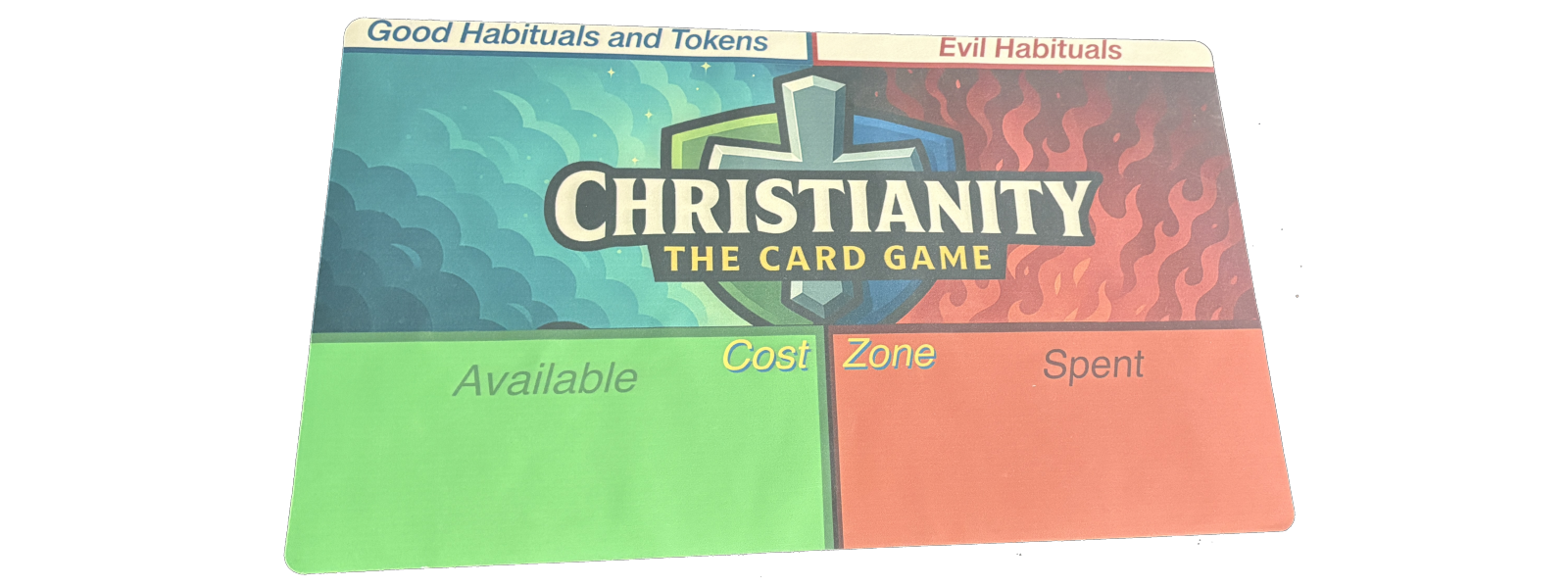
The four squares above, in the order they are named.
Co-op/Original Turn Phases
Righteous Side against the Evil Deck (automated).
The first phase: untap (un-rotate) all your cards.
Check for active conditions and status effects.
Draw cards equal to Maturity + 2.
Play up to 4 cards face-down from your hand to your Cost Zone. No other card types can be played this phase.
Evil draws and plays the same number the Righteous player draws, minus 1.
Exception: if the Righteous player is at Maturity 2+, Evil draws and plays Maturity + 2.
Resist temptation or suffer Chaos. Play Resistance and Unction cards. Every active temptation is then settled one way or the other: resisted, or failed.
Play Maturity, Habitual, and Token cards. Rotate field cards to activate abilities. Unction cards may be played now.
Discard down to your hand limit. Nothing else happens here — this is where the turn ends and passes on.
Slight Distraction From The Will of God
A Temptation — played at you, not by you
Evil plays these at a Righteous player. A Temptation sits active until the Resistance phase, where it is resisted or it lands. It is the only kind of card that costs you something for ignoring it, which is what makes the Cost Zone worth filling before you need it.
Overcome Evil With Good
A Resistance card — what you answer with
In the Resistance phase every active Temptation is answered or failed. This is what answering looks like: pay what the Temptation asks and it is resisted, which sends it to the discard pile and costs you nothing. Fail it instead and you lose Humility H-1 — so the real question each turn is whether the cost is cheaper than the point.
Read Chapter
An Unction — the card that ignores the clock
Unctions are the exception to whose turn it is. One may be played at almost any time, yours or not, and the only phase closed to them is the Cost Zone Phase. Play several and they stack: the last one played resolves first. It does its work and goes to the discard pile — nothing of it stays on the field.
Uncaring Attitude
Rotating — how a card is spent
#rot# means rotate this card: turn it sideways to show it is spent. That is how a cost is paid — a cost of C2 rotates two cards in your Cost Zone — and how some cards charge for their own ability. A rotated card does nothing further until it stands up again #unr# in your Reset phase.
Humility & Maturity
Start at 3/10 Humility. Humility is changed only by card effects (e.g. "Gain X Humility" H+X, "Resist an Ambush → Gain X −3 Humility") and by failing temptations: −1 Humility H-1 if you have any; if Humility is already 0 H0, the overflow forces a discard per point — from hand OR Cost Zone (your choice). Placing cards in the Cost Zone does not change Humility.
Reach Maturity L3 on all righteous players to win. Level up Maturity by playing Maturity-type cards: each resolved Maturity card raises your Dependence level by 1 (0 → 1 → 2 → 3).
Maturity Abilities — "Mature Together"
The Righteous team can unlock shared abilities. Each time all players reach the next Dependence Level (L1, L2, L3), you collectively choose one ability for the whole team — free. You may also purchase an ability by spending Cost (11 high-tier / 7 low-tier) right after your own Cost Zone phase (from the abilities bar, bottom-left).
- Benevolence / Double Resistance — any player may spend their own Cost Zone to help resist a temptation (not just the targeted player).
- Brotherly Love — redirect your next card's beneficial effect to a teammate.
- Restoration — once each time all players reach a new Dependence Level, every Righteous Player shuffles up to 15 random cards from their discard pile back into their own Deck. Recharges at every new shared level.
- Deliverance — once each time your team reaches a new Dependence Level, break up to 3 Evil Habituals in play (removed to the Resisted pile). Recharges at every new level.
- Vibrancy — flip 2 Cost Zone cards face-up after your Cost phase.
- Cost Zone Power — gained 3+ Power this turn? Draw a card straight to your Cost Zone at end of turn.
- Speed — play 1 Habitual/Maturity card at any time on your turn.
- Foresight — reveal the Evil Deck's next draws at the start of your Cost phase.
Co-op Win Conditions
Righteous Win: All players reach Maturity Level 3 (L3) or greater and there are no Evil Habitualsin play for one full round.
Evil Wins: The Righteous side has not won by the end of round 10.
The clearing round - All Righteous Players have reached L3 Maturity
Reaching L3 is not the win if there are still any .eh in play; it starts the clock on it. The moment the last player reaches Maturity L3 (other Righteous Players can have higher Maturity Level, a clearing round opens, and it runs from the start of that player's turn until their next turn begins — one full round, every seat getting one turn inside it.
- Clear all Evil Habituals by the end of the clearing Round.
- Still one in play when the round closes and the Righteous side loses — unless round 10 has not finished yet.
That last clause is the whole of it, so it is worth stating on its own: the clearing round never ends before the end of round 10, and it is never shorter than one full round.
- L3 reached in round 9. The clearing round runs to that player's next turn, in round 10. If an Evil Habitual is still standing then, the table keeps going to the end of round 10.
- L3 reached in the middle of round 10. The round is nearly over, but the clearing round still gets its full length — to the beginning of that player's next turn — even though that is past the end of round 10. Nobody loses for reaching L3 late.
Duel Mode
Righteous decks against Evil decks. Experimental.
Duel Mode — Righteous vs Evil decks (experimental)
A head-to-head variant: any number of players split into two sides — at least one Righteous deck and one Evil deck (the Evil deck: Temptations and Evil Habituals). Righteous seats share the Righteous win; Evil seats share the Evil win.
Un-rotate all your cards, then check conditions.
Righteous: Maturity + 2 (+ outnumbered bonus). Evil: the strongest Righteous player's Maturity + 2 (+ outnumbered bonus) — Evil never matures, so its draw tracks the top Righteous level.
Righteous: play up to 4 cards/turn face-down to your Cost Zone. Evil: no per-turn cap — bank as much Cost as you can lay.
Evil plays Temptations (instant speed) and Evil Habituals onto the shared field. Righteous plays Maturity/Habitual/Token/Resistance cards and rotates field cards for abilities.
Discard to your hand limit. Any threat you didn't resist gets through (see below).
Turns
Evil goes first, and the sides do not alternate: every Evil seat takes its turn, then every Righteous seat (E E → R R → E E…). Evil opening is the point — the Righteous side answers a board that already has something on it.
Every seat, either side, takes the same full turn: Draw → Cost Zone → Main → End of Turn. There is no separate Evil or Resistance phase in a duel — threats are answered the moment they land.
Attacking & Defending
Laziness
What an attack costs the attacker
An attack is not free to make. The cost in the corner is paid by the seat that plays it — C2 rotates two of their own Cost Zone cards — so a big Temptation is also a turn the Evil seat spent. Reading the cost tells you what they could not also afford to do.
- Evil plays at instant speed. A Temptation or an Evil Habitual may be played at almost any time — including in the middle of a Righteous player's turn — aimed at whichever Righteous player Evil picks.
- One limit, and everyone shares it: no plays while a player is laying their Cost Zone. Before or after, never during.
- You answer immediately. The moment a threat is aimed at you, you get a window to resist: rotate Cost Zone cards or play a Resistance card, even on somebody else's turn.
- And only then. There is no separate Resistance phase in duel mode, so a Resistance card may be played only in response to a Temptation or an Evil Habitual — never on its own, and never held out in front of you before one arrives.
- Evil may keep coming for as long as it can pay the Cost of each threat. You answer each one on its own.
- What gets through, sticks. An unresisted threat costs you −1 Humility, and an Evil Habitual takes hold — blocking your L3 win until it is resisted.
Evil Combo — back-to-back plays get cheaper
- First play full price, the next C1 less, then C2 less, and so on.
- A play that lands free (C0) restarts the chain.
- The chain also resets when the Righteous side responds — resists, or takes the hit — and at the next turn.
- With more than one Evil seat you cannot combo against yourself: a partner has to play the next card. One Evil deck alone may chain solo.
Habitual Dominance — a standing discount
- C1 less on all your cards per 3 of your own Evil Habituals in play — ones that took hold and were not resisted. 3 → C1, 6 → C2, and so on.
- Only that seat's own Habituals count, never a partner's.
- It falls again as Habituals leave play.
- Righteous resistance is untouched. Each temptation is still resisted at its written cost.
Evil Micro-Rewards
An Evil seat earns a micro-reward in either of these ways:
- Habitual pair — you have 2 of your own Evil Habituals unresisted and both in play at the same time. That pair is then spent (flagged) and never counts again; the next pair you hold in play (any turn) earns the next reward. A Habitual resisted/removed before it pairs never counts.
- 4 plays in a turn — you play 4 cards on a single turn (resisted or not). Every 4th play that turn earns a reward.
- 3 failed temptations in a turn — when 3 non-Habitual Temptations get through unresisted in one turn (counting all Evil seats together), the seat that played the 3rd (last) one earns a reward. Every 3 that turn triggers again.
- Combo finale — chain your plays (see Evil Combo) all the way down to a free (C0) card, aimed at one Righteous player (a chain must stay on a single target). If the righteous player does not resist that free finale, every Evil seat that played into the chain earns a reward. (So the righteous player will usually want to resist the free finale to deny it — but that's their call.)
For each reward, that seat chooses one of:
- Draw 2 cards.
- Untap 2 Cost Zone cards (frees Cost to spend).
- Flip 2 random Cost Zone cards face-up (so the Righteous side sees them coming) — each becomes a playable card (and is still tappable for mana) with a play-replace-spent flag: when you play one you immediately draw a card from your deck into your Cost Zone tapped (a spent replacement). You can tap face-up Cost cards for mana and use it to play them.
- Destroy a Righteous Habitual (special — only available on every 5th micro-reward this turn, counting all Evil seats) — remove one Righteous Habitual in play (or in hand) from the game (the Evil side agrees which).
On a 5th (special) reward, you may also direct any of the rewards (Draw / Untap / Flip) to another allied Evil player instead of yourself.
Same-turn bonus. If you rack up rewards fast, you get an extra one:
- Solo Evil — earn 2 rewards in one turn → 1 extra reward (per 2 earned).
- Multiple Evil seats — if 2+ Evil seats each earn a reward on the same turn, every earner gets 1 extra reward (you may pick the same one again).
Righteous Micro-Boosts
Lacking Wisdom
A boost — the extra you may pay for
The band across the foot is a boost: an offer attached to the card, not a separate play. The card's own action resolves first, then the boosts top-down as printed. The glyph says who may pay — #self-boost# you, #any-boost# anyone at the table, #brotherly-boost# another player on your behalf. Paying is always optional.
The Righteous side earns micro-boosts two ways (both count all Righteous players together):
- Cards per phase — every (3 + number of Righteous players) cards the Righteous side plays in one phase earns a boost. (So 4 cards with 1 Righteous player, 5 with 2, 6 with 3…) Only played cards count — using a Maturity Ability does not. The tally resets at the start of each phase.
- Clean resistance streak — if a Righteous player resists 3 Temptations / Evil Habituals in one turn (by any means — Resistance card, tapping Cost, or breaking a Habitual with an ability) without any Temptation being failed that turn, they earn a boost. If a Temptation is failed that turn, the streak is voided for the rest of the turn.
For each micro-boost, the Righteous side chooses one — and may give it to any Righteous player (more options added later):
- Draw 2 cards.
- +1 Humility (progress toward the next Dependence Level).
Cost Zone & Draw per side
Knowing The Gospel - The Law
Drawing off a card
D2 on a card means draw that many, on top of the draw the phase already gives you. Worth reading against the hand limit at the end of the turn: cards drawn are cards you may have to discard if you cannot spend them, and a card spent into the Cost Zone is a card that keeps paying.
- Righteous — opening Cost Zone (one-time, at game start): 3 + (extra opponents) cards. Draw each turn: own Maturity + 2 + (extra opponents). Cost intake capped at 4/turn.
- Evil — opening Cost Zone (one-time, at game start): 3 + (extra opponents) cards (same as Righteous). Draw each turn: when outnumbered, Evil draws the sum of every Righteous player's draw — Σ (their Maturity + 2). Example: one Righteous at L1 and one at L0 → 3 + 2 = 5. When not outnumbered it's the top Righteous Maturity + 2. Cost intake capped at 4 + 2 × (extra opponents) per turn (so 4 when not outnumbered, 6 when outnumbered by one, …). Evil's Maturity-tracking draw + outnumbered bonuses are its counterweight to never leveling up.
"Extra opponents" = how badly a side is outnumbered — the other side's seat count minus your own, never below 0. The outnumbered handicap is now the same for both sides (+1 opening Cost + 1 draw per extra opponent). Only the smaller side gets it; an even match (1v1) gives neither side one.
"Maturity" = your current level; "top Maturity" = the strongest Righteous player's level (Evil never matures, so its draw tracks it).
Humility & Maturity
Start at 3/10 Humility. Humility changes only via card effects and by failing temptations: −1 Humility (Power) if you have any; if your Humility is already 0, the overflow forces you to discard a card per point — from hand OR Cost Zone (your choice). Level up Maturity by playing Maturity-type cards — but Maturity may only grow 1 level per turn in a duel (no racing to L3 in one turn). Need to clear stuck Evil Habituals for the win? Unlock the Deliverance Maturity Ability (see below) — then use it once per level-up to break up to 3.
Duel Win Conditions (no round clock)
Righteous win: every Righteous player reaches Maturity L3 and there are no Evil Habituals in play — and that clean state must hold for one full round (mirroring the Evil win). Reaching L3 with a clear board arms the win; if any Evil Habitual comes back into play during that round (even one that's then removed), the countdown resets and you need a fresh full clean round. Take as long as you need — there is no time limit.
Evil side wins: Gets 7 Evil Habituals in play per Evil player (1v1 = 7, 2 evil = 14 …) and keep them there for a full round. Habituals count whether they've taken hold on a player or are sitting on the field. The moment the limit is hit, the Righteous side gets one full round — their next turn — to resist one back below the limit and avert the loss. See it on the board, answer it on your turn; only if it survives does Evil win.
Stalemate? Neither side is forced to end the game, but the app tracks a running score to break a drawn‑out game — Righteous: Maturity ×5 + Resisted pile; Evil: Failed pile + Habituals in play ×5.
Maturity Abilities — "Mature Together"
The Righteous side can unlock shared abilities in duel too. Each time you reach the next Dependence Level (L1, L2, L3) you choose one ability — free. In duel there is no buying with Cost — abilities are earned only by leveling up. Double Resistance is available only at Dependence Level 2 or higher.
- Benevolence / Double Resistance — spend/rotate your own Cost Zone to resist a temptation.
- Brotherly Love — redirect your next card's beneficial effect (self in 1v1).
- Restoration — once each time you reach a new Dependence Level, every Righteous Player shuffles up to 15 random cards from their discard pile back into their own Deck. Recharges at every new level.
- Deliverance — once each time you reach a new Dependence Level, break up to 3 Evil Habituals in play (removed to the Resisted pile). Clears the board toward the "L3 + no Habituals" win. Recharges at every new level.
- Vibrancy — flip 2 Cost Zone cards face-up after your Cost phase.
- Cost Zone Power — gained 3+ Power this turn? Draw a card straight to your Cost Zone at end of turn.
- Speed — play 1 Habitual/Maturity card at any time on your turn.
Rule Differences Grid
The two modes side by side, then the rules that do not change.
Co-op and duel, side by side
| Co-op | Duel | |
|---|---|---|
| Who plays Evil | Nobody. The deck runs itself to fixed rules. | A person, choosing every play. |
| Solo, 1 player | Yes — with the Target-Change fee. | No. A duel needs somebody on each side. |
| Turn order | Each Righteous seat takes a turn; the Evil deck acts inside it. | Evil first: all Evil seats, then all Righteous seats. No alternating. |
| The turn | 8 steps, including an Evil phase and a Resistance phase. | 5, the same for every seat: Draw, Cost Zone, Main, End of Turn. |
| Answering a threat | In the Resistance phase, once a turn. | The moment it lands, on anyone's turn. There is no separate Resistance phase in duel mode: Resistance cards may be played only in response to a Temptation .t or an Evil Habitual .eh. |
| Evil's economy | Fixed by the rules. | Combo discount, Habitual Dominance, micro-rewards. |
| Righteous extras | — | Micro-boosts. |
| Round clock | Yes. | None. |
| Righteous win | All Righteous at Maturity L3 with no Evil Habituals in play. The same in both. | |
| Evil win | The clock, or Humility gone. | Humility ground to nothing. No clock. |
Game modesCo-op: the deck plays Evil · Duel: a person does
Co-op (the original game)
Any number of players on the Righteous team, together against the Evil deck. Nobody plays Evil: the deck runs itself to a fixed set of rules, and the table wins or loses as one.
Solo — one player
The co-op rules, played alone: your Righteous deck against the Evil deck.
Solo plays fine with the many cards that do not involve another player on your team. For a card that does need one — a boost somebody else would pay, an effect aimed at a teammate — pay a Target-Change fee of C1 and read the card as pointing at you. Pay it the ordinary way, by rotating #rot# a card in your Cost Zone.
Raise the fee to C2 or C3 for a harder game.
Duel (experimental)
People on both sides. One or more players run Righteous decks; one or more run Evil decks, choosing which Temptations and Habituals to play and who to play them at. That is the whole difference: in co-op the Evil deck follows fixed rules and cannot think, and in a duel it can. The Righteous side still wins by Maturity; the Evil side wins by grinding Humility to nothing. Everything in the duel half of this book is the machinery that keeps a played Evil side fair — micro-rewards, micro-boosts, and a Cost Zone sized to how outnumbered each side is.
Playing a Card — the order of things
Every play follows the same five steps, whoever made it and whatever the card is. Boosts are not an exception to this; they are step five.
- Pay for the card and play it.
- It may be resisted. The resistance cost on the card — R5, RX — is what answering it takes. Resisted, it never reaches the stack and nothing on it happens.
- Unresisted, it goes on the stack, ready to resolve.
- If nothing else is played onto the stack — an instant, a fast card — the card resolves fully: its rules text first, and then its boosts.
- Boosts, in any order. Whoever is allowed to pay may take any boost on the card, in whatever order they like — the printed order is how they are listed, not a sequence you are held to. Nothing is taken that is not paid for.
A boost goes on the stack like a card
Pay for a boost and its action goes on the stack, exactly as if it had been played as a card of its own. The same window opens: anyone may respond, and a response goes on top.
But a boost action cannot be countered — as the game stands today. A response can do its own work around a boost, and it can change what the boost lands on, but nothing takes a paid boost off the stack.
The boosts belong to the player who played the card, whoever is allowed to pay for them: the glyph says who may pay, never who decides.
The exception is marked on the card
A boost that changes what the card itself is about to do cannot wait until afterwards — by then there is nothing left to change. Those carry the fast mark, a bolt before the boost glyph, and they are taken before the card's own action. Everything else about them, the stack included, is unchanged.
If a card shows no bolt, its boosts are offered after the action. The bolt is the only thing that moves a boost earlier, so a card cannot be ambiguous about its own timing.
Boosts printed at the top of a card
Some cards print their boosts above the rules text. On those cards, if the card was boosted, its boost actions resolve first, before the rules text below them — which is what lets a rule ask whether it was boosted. A card with its boosts at the foot keeps the ordinary order.
For example:
#bb# C5: Choose one below and do it.
If this card was boosted, do both, otherwise choose one:
– D3 to .hand
– D1.cz .fup
Paid for, the first boost resolves before the card's text and does nothing but mark it boosted — so the rule underneath then does both. Unpaid, the card is not boosted and its controller chooses one. The second boost is a choice of its own, made when it resolves, before the rules text.
The Marks on a Card
Every symbol a card can carry, and what it means. These are the real marks, drawn by the same code that prints the cards — so this list cannot fall out of date with the deck.
Humility Loss at 0 (Overflow Rule)
Reset
Gaining Humility back
Humility only moves when a card says so. This one says so: H+1 puts a point back, up to the ceiling of 10. The timing is the whole of it — a point gained before the Resistance phase is a point you can afford to lose in it; gained after, it is only insurance for next turn.
If a card causes you to lose Humility H-1 while already at 0 H0, you must discard 1 card per Humility lost from your hand or Cost Zone.
The Cards
What the words above look like in your hand.
Growth by Power
A Habitual — it stays
Played from your hand in the Main phase. A Habitual does not resolve and leave: it stays on the field and keeps doing what it says for the rest of the game, or until something breaks it. The cost in the corner is paid by rotating cards in your Cost Zone — C2 means two of them.
Covet Someone's Vacation
A Temptation — resist it or it lands
This one is played at you, not by you. In the Resistance phase you either pay to resist it or you fail it, and failing costs you Humility H-1. If you are already at H0 you discard a card for each point instead. Resisted, it goes to the discard pile and is over.
He Gave His Only Son.
A Maturity card — how you level up
Maturity is how you win, and this is how you gain it. Play it in the Main phase and your Level goes up — L0 through L3 — which also raises the number of cards you draw each turn, because the draw is Maturity + 2. One Level per turn.
Cleverly Devised Fables
A card with a boost
The band across the foot of this card is a boost: an extra effect you may pay for on top of the card itself. Play the card, its own action resolves first, and then the boosts resolve top-down in the order they are printed — all of it belonging to the player who played the card.
The glyph at the start of the band says who may pay: #self-boost# only you, #any-boost# anybody at the table, #brotherly-boost# another player on your behalf. Paying is always optional; an unpaid boost simply does not happen. A stone #permanent# in front of it means the boost stays rather than resolving once, and a bolt #fast-any-boost# is the one exception to the order above — it resolves before the card's own action.
A card that prints its boosts at the top, above its rules text, resolves them first when it was boosted — so its rules can say “if this card was boosted…”. A boost there that only says “this card is marked as boosted” exists for exactly that.